

On the eve of World Environment Day, environmental groups yesterday staged a demonstration urging the president to rethink the nation’s nuclear power policy.
The Taiwan Environmental Protection Union (TEPU), together with 13 civic environmental groups and legislators, gathered on Ketagalan Boulevard in Taipei with yellow banners that read: “I love Taiwan, not nuclear disasters.”
They said that World Environment Day was set up to remind people to pursue economic development and improvement in quality of life under the premise that the environment cannot be sacrificed.
The nation’s unchanged nuclear power policy is in contrast with the government’s promotion of World Environment Day, TEPU secretary-general Lee Cho-han (李卓翰) said, adding that nuclear power harms the environment and departs from the goals of sustainable development.
They protested against prolonging the life of the nation’s three operating nuclear power plants and the construction of a fourth plant. They also called for all nuclear power plants to be thoroughly re-evaluated and shut down immediately if they fail to pass safety inspections.
“According to the weekly journal Nature, Taiwan has two nuclear power plants with more than 3 million people living within a 30km radius ... and if a level-seven nuclear crisis were to happen in Taiwan, it would destroy the nation,” said Wang To-far (王塗發), an economics professor at National Taipei University.
Wang said that while Germany has decided to shut down all its nuclear plants by 2022 and other nations are reconsidering their nuclear policy, President Ma Ying-jeou (馬英九) should do the same.
Wild at Heart Legal Defense Foundation chairman Robin Winkler said the Ma administration was irresponsible, as it was afraid of offending businesses on World Environment Day.
If the government will not stand up to protect the people, then the people will have to find ways by themselves, he said.
Coinciding with World Environment Day, the Environmental Education Act (環境教育法) comes into force today.
The law, passed last year, obligates the central and local governments to set up environmental education funds and establish authentication systems for environmental education agencies, personnel and facilities.
Staff at government branches of all levels, including the president and the premier, and employees of state-run enterprises are required to take four hours of environmental protection classes each year.
People who disobey the law could be fined at least NT$5,000 or forced to shut down operations and take up to eight hours of environmental education lessons.
To celebrate World Environment Day, the Environmental Protection Administration is inviting the public to log on to its “EcoLife” Web site (http://ecolife.epa.gov.tw), which offers tips on how to save electricity, reduce carbon emissions and other information on environmental protection.
A series of activities promoting environmental awareness will also take place nationwide today, includes beach clean-ups, lectures, second-hand book sales, eco-friendly markets, as well as hiking in Miaoli County and a film display at the Wugu Wetland Ecological Park education center.
For details of the activities, visit the official Web sites of the local governments.
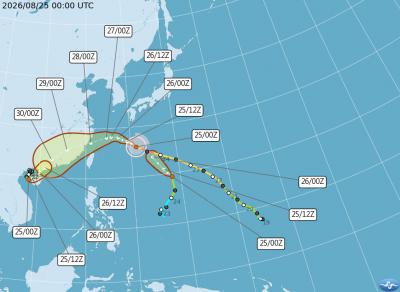
Typhoon Saudel has shown signs of weakening but is still expected to affect Taiwan when it comes closest to the nation on Friday, the Central Weather Administration (CWA) said today. The radius of Saudel shrank to about 220km as of 8am today from 250km a day earlier, and its maximum sustained winds were down to 155kph from 184kph previously, the weather agency said. As of 8am, Typhoon Saudel was 980km east of Taipei, moving west-northwest at 18kph, it said. Under the influence of a Pacific high pressure system, the storm is moving northward, meaning it is less likely to make landfall in Taiwan,

Minister of Sports Lee Yang (李洋) today said the Chinese Taipei Basketball Association (CTBA) has been urged not to undermine Taiwan’s credibility in international competitions, after a Taiwanese team advanced to the semi-finals of the 45th William Jones Cup over the Philippines last week due to a controversial new rule guaranteeing a semi-final place to the host team. The Republic of China Blue team advanced to the semi-finals after winning just one game in the group round due to a “host guarantee” spot, overtaking the Philippines, who held a 5-1 record ahead of the semi-finals. The Blue team finished the tournament
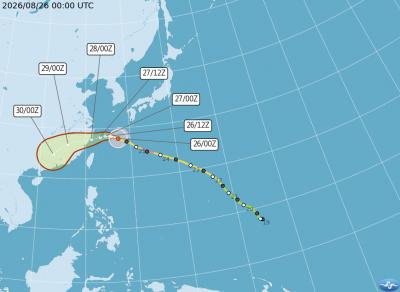
A sea warning for Typhoon Saudel, which has shifted to a more northerly track as it nears Taiwan, is expected early tomorrow, the Central Weather Administration (CWA) said today. As of this morning, Saudel was about 650km east-northeast of Taipei, moving west-northwest at 12kph with maximum sustained winds of 162kph, CWA data showed. Although Saudel remains a moderate typhoon, it has weakened and is expected to weaken further as it nears Taiwan due to unfavorable atmospheric and ocean conditions, CWA forecaster Lin Po-tung (林伯東) said. The storm is forecast to make its closest approach to Taiwan tomorrow and on Friday, Lin added. According to
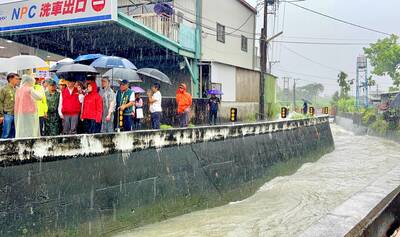
SEA WARNING EXPECTED: As atmospheric conditions are unfavorable for its development, the storm’s intensity is continuing to weaken, a CWA official said Typhoon Saudel is continuing to weaken and shift its path northward, with a sea warning expected to be issued this evening, the Central Weather Administration (CWA) said yesterday. The agency did not rule out issuing a land warning for outlying Lienchiang County (Matsu) tomorrow morning, although all storm warnings could be lifted by Friday night. Saudel is expected to be closest to Taiwan from tomorrow night to Friday, bringing localized heavy rain to northern and southern Taiwan, as well as central mountainous areas, the agency said. As of 2pm yesterday, the center of moderate Typhoon Saudel was about 890km east-northeast


 RSS
RSS